November 29, 2025
The hotel industry is highly cyclical. The demand generally rises in economic booms (when corporations spend, people travel, and discretionary incomes rise) and falls in economic downturns.
There’s also seasonal demand variation: for many hotels, demand peaks during festive seasons, holidays, business-heavy weekdays (especially Monday–Thursday), and major events. The demand dips during off-season, monsoon months, or economic slowdown.
Because of this, hotels, especially full-service and luxury ones, see volatility in occupancy rate, Average Daily Rate (ADR), Revenue Per Available Room (RevPAR), and profits. A strong macro economy or tourism boom can boost revenues sharply, but downturns or oversupply can hit performance hard.
India has 3.4 million hotel keys as of FY24. Out of which, only ~11% or ~3,74,000 keys belong to the organised segment. The organised segment is further divided into branded and independent hotels, of which branded hotels constitute approximately 45% of the keys, i.e., ~169,000 keys.
India’s hospitality industry presents significant potential for market penetration, as there are only ~1.2 branded rooms per 10,000 people. The branded-hotel pipeline has crossed 100,000 rooms, which will get operationalised over the next 5 years.
In the last 2 years, several hotel companies have been listed, such as Brigade Hotel Ventures, Schloss Bangalore (Leela Hotels), Ventive Hospitality, Juniper Hotels, and Appejay Surrendra Park Hotels. They collectively raised ₹8,500+ crores. These IPOs signal strong investor interest in the hospitality sector amid growing domestic travel demand.
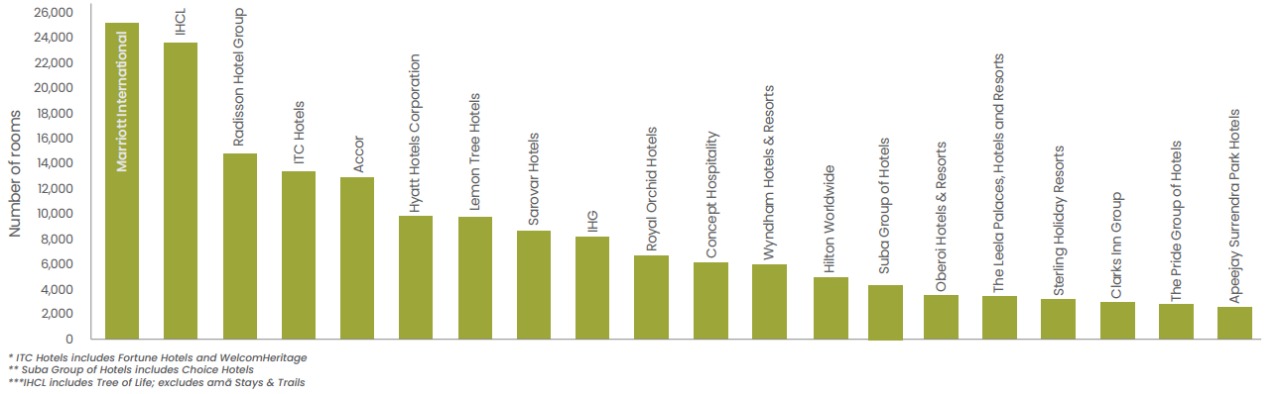
The chart below shows the top 20 hotel brands by existing inventory as of FY25.
Source: Hotelivate
Hotel Classification:
1) Branded vs Independent:
a) Branded Hotels: Operate under a recognised chain or hospitality brand such as Taj, Marriott, etc. They may be owned, leased, managed, or franchised, but carry the brand’s name, standards, systems, and loyalty program.
b) Independent Hotels: Meet formal regulations and hospitality standards, but do not operate under a chain brand.
2) Positioning:
a) Luxury: Ultra-premium hotels offering personalised service, exclusive amenities, and iconic locations. Designed for high-spend guests seeking unique experiences and exceptional service standards.
b) Upper Upscale: High-end full-service hotels with premium rooms, strong F&B, and extensive facilities. Targets affluent business and leisure travellers at slightly lower price points than luxury.
c) Upscale: Quality full-service hotels with solid amenities, good locations, and reliable guest experience. Positioned as premium yet mainstream, appealing to both business and leisure guests.
d) Upper Midscale: Comfort-focused hotels with limited luxury touches, efficient design, and value-driven offerings. Often popular with business travellers needing convenience without premium pricing.
e) Midscale: Standardised, affordable hotels delivering essential services and consistent quality. Competes on value, not luxury, focusing on clean rooms and dependable service.
f) Economy: Basic, no-frills accommodation with limited services and compact rooms. Designed for functional stays at low prices, catering to cost-conscious travellers.
g) Budget: Bare-minimum service, often highly compact and price-driven, focusing only on core lodging needs. Popular for short stays, transit stops, or deeply price-sensitive segments.
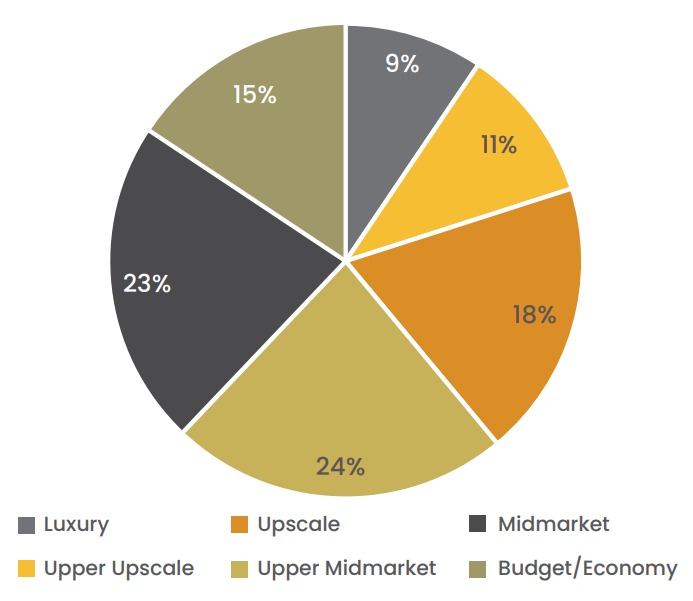
The bifurcation of branded hotels by positioning as of FY25:
Source: Hotelivate
Key Industry Insights:
1) Industry Phases:
The Boom: FY03–08
This period saw strong demand growth driven by rising business travel and limited new supply. Occupancies climbed to peak levels of ~71%, enabling hotels to aggressively push room rates, which leads to rapid RevPAR expansion.
Flat Growth: FY09–15
Post-global financial crisis, room supply grew faster than demand, causing occupancies to soften from ~69% to ~58–60%. With more hotels entering the market, pricing power weakened, leading to flat ADR and stagnant RevPAR despite stable demand.
Recovery: FY16–20
Demand began strengthening again, outpacing new supply, helping occupancy recover to ~66%. Although ADR growth was modest, improving occupancy lifted RevPAR, indicating a demand comeback after years of supply pressure.
Covid Slump: FY21–FY22
The pandemic caused an unprecedented collapse in mobility and travel, pushing occupancy down to just ~35% in FY21. Revenue dropped sharply, but domestic leisure and “revenge travel” triggered a quick rebound in FY22, setting the stage for a strong recovery.
Post-Covid Growth: FY23–FY25
After a steep slump to 34% occupancy in FY21 during Covid, a sharp rebound followed, supported by pent-up leisure demand, weddings, and domestic tourism. Occupancy (~68%) and ADR surged together, creating one of the strongest pricing environments in recent history.

Source: Hotelivate
2) Business Models:
There are various business models under which the hotel brands operate. Therefore, an investor will notice a stark difference in the profit margins between the different hotel companies. However, before jumping to conclusions, an investor should check which business model the hotel chain is operating under. Some of the business models are:
a) Owned: The company owns the land and building and operates the hotel itself. It gets full control and full profits but bears high capital cost, development risk, and lower returns due to heavy assets.
b) Lease: The company leases the property from a landlord and runs the hotel as its own. It requires lower upfront investment than owning, but fixed lease payments create risk during downturns.
c) Managed: A hotel brand operates the property on behalf of the owner for a management fee. The brand provides expertise, systems, and training, while the owner funds the asset, making it an asset-light model for the operator with lower risk.
d) Franchise: The owner runs the hotel independently while using a brand’s name, reservation system, and standards by paying a franchise fee. The brand provides marketing and guidelines, but daily operations and performance responsibility lie with the owner. It is cost-efficient but dependent on the owner’s capability.
e) Subscription: Customers pay an upfront fee and recurring annual charges to secure long-term holiday rights – typically for 20–30 years. Instead of paying per night, members pre-purchase future stays, giving the operator predictable cash flow, higher customer stickiness, and lower occupancy risk. For example, Club Mahindra runs a 25-year subscription model.
Profit margins are highest in the managed and franchise business model, as it is an asset-light model. It requires no or very low capital investment from the hotel brand, as the owner funds the land and building. The brand only provides systems, standards, and marketing, while earning predictable fees with minimal risk. The management fee ranges from 5–10% depending on the brand’s negotiating power.
3) Revenue Sources:
a) Room Revenue: This is the primary income source, driven by occupancy and ADR. It includes charges for room nights, upgrades, early check-ins, and late check-outs. High-margin and least variable, room revenue is the core profit engine of most hotels.
b) Food & Beverages: Revenue from restaurants, cafes, lounges, bars, and room service. While F&B boosts total guest spend and draws local walk-in traffic, margins are lower due to high labour and ingredient costs.
c) Banquets & MICE: Income from ballroom rentals, meeting rooms, weddings, corporate events, and social gatherings. This is a high-volume, high-impact revenue stream that can significantly lift both occupancy and F&B sales. In strong seasons, banquets become a major RevPAR booster.
d) Spa, Wellness & Recreation: Revenue from spa treatments, wellness therapies, salons, fitness centres, yoga sessions, and pool facilities. Particularly important for luxury hotels and resorts, this segment enhances guest experience and contributes to higher ancillary spend.
e) Ancillary Services: Includes laundry services, airport transfers, valet/parking fees, concierge services, and business centre charges. These services provide a steady supplementary income and improve convenience for guests, especially business travellers.
f) Retail & Shop Rentals: Hotels often lease space to boutiques, jewellery shops, souvenir stores, or cafes. Rental income is stable and low-maintenance, helping diversify revenue while enhancing guest convenience.
g) Memberships & Subscriptions: Some hotels or resort chains earn revenue through gym/spa memberships, club memberships, or long-term vacation ownership subscriptions. This provides predictable recurring income with low operational volatility.
h) Management & Franchise Fees (For Asset-Light Operators): Brands operating managed or franchised hotels earn revenue through percentage-based management fees, franchise fees, and incentive fees. This is a high-margin, asset-light revenue stream where the hotel brand earns without owning physical assets.
i) Long-Stay Programs & Serviced Apartments: Extended-stay guests, corporate tie-ups, and apartment-style units generate consistent occupancy and predictable revenues. These stays often come with lower servicing costs per night, improving margins.
4) Cost Drivers:
a) Payroll & Staffing Costs: One of the largest expenses, covering salaries, benefits, training, and incentives for front office, housekeeping, F&B, kitchen, engineering, and admin staff. Labour-heavy departments like F&B and housekeeping especially drive up cost. Higher service levels in upscale / luxury hotels make this cost even more significant.
b) Utilities (Electricity, Water, HVAC): Hotels operate 24/7 and consume large amounts of electricity for air-conditioning, heating, lighting, laundry, and kitchen operations. Utility costs rise sharply during peak seasons or extreme weather months. Efficient energy management directly improves operating margins.
c) Food & Beverage Cost (COGS): Includes raw materials for restaurants, bars, banquets, and room service. Ingredient inflation, wastage, spoilage, and menu mix heavily influence this cost line. F&B has lower margins compared to rooms, making cost control critical.
d) Repairs, Maintenance & Engineering: Covers upkeep of rooms, plumbing, electrical systems, HVAC, elevators, and common areas. Preventive maintenance is essential to avoid breakdowns and maintain guest satisfaction. Older properties or resorts with large landscaped areas have higher maintenance costs.
e) Sales, Marketing & Distribution Costs: Includes OTA commissions, brand marketing fees, loyalty program costs, and digital advertising. OTA commissions (12–25%) can significantly erode margins, making channel mix management important. Corporate sales teams and partnerships add to the cost base.
f) Property Taxes, Insurance & Compliance Costs: Hotels pay substantial local taxes, statutory fees, fire safety compliance, and insurance premiums. These are largely fixed and unavoidable, impacting cash flows regardless of occupancy. Regulatory compliance in India can also add hidden costs.
g) FF&E Reserve (Furniture, Fixtures & Equipment Replacement): Hotels typically set aside 3–5% of revenue annually to refurbish rooms, replace furniture, upgrade soft furnishings, and maintain brand standards. Luxury and upper-upscale hotels require higher reserves due to faster wear and tear expectations.
5) Demand and Supply in Luxury Hotels:
The Indian luxury hotels remain significantly underpenetrated, compared to global cities. As of Mar’24, there were 23 luxury hotel keys per million people in India, which is much lower than those of major countries such as Australia (973), Thailand (690), and China (177).
Demand in India’s luxury hospitality segment is projected to grow at a CAGR of 10.6% between FY24 and FY28, significantly outpacing the expected supply growth of 5.9% over the same period.
The supply in the luxury segment is expected to remain constrained due to high barriers to entry, including limited availability of land, extensive regulation, restrictive zoning, high cost of capital and long gestation periods.
6) Construction Costs and Timeline:
In India, the construction cost per room, inclusive of everything, varies significantly by segment. Budget/Economy hotels range from ₹35-65 lakh per key, Midscale/Upper Midscale from ₹60 lakh-₹1.5 crore, Upscale/Upper Upscale from ₹1.5-2 crore, and Luxury from ₹2-5+ crore, depending on the location, size, and specifications. For example, Indian Hotels Company is investing ₹2,500 crore in building Taj Bandstand, which comprises ~450 keys, i.e., ~5.55 crore per key.
Construction timelines from groundbreaking to completion typically span 12-18 months for Budget/Midscale, 18-24 months for Upscale, and 24-36+ months for Luxury projects due to complex designs, approvals, and premium finishes. Pre-construction (approvals/design) adds 6-12 months, with total project timelines often extending to 24-48 months amid delays due to monsoons or regulations.
7) Shift Towards Asset Light Model:
Many of India’s major hotel companies are increasingly leaning on managed/asset-light business models using management contracts or revenue-sharing leases rather than owning every hotel property. This shift helps them expand rapidly with minimal fixed capital, keeps balance sheets light, and improves return on equity and operational leverage.
For example, Lemon Tree Hotels is rapidly shifting toward a management contract-led, asset-light strategy. As of Q2 FY26, managed and franchised hotels account for ~48% of its operational portfolio, while an overwhelming ~92% of its upcoming pipeline consists of managed or franchised properties. The company is preparing to spin off a separate entity (“Fleur Hotels”) for owned assets, effectively bifurcating its asset-heavy and asset-light businesses. This clearly shows the company’s pivot toward faster, capital-efficient expansion.
The Indian Hotels Company, under its “Accelerate 2030” mission, plans to increase its managed hotel mix to 63% of its total portfolio.
8) Other Trends:
a) MICE: Meetings, Incentives, Conferences & Exhibitions (MICE) are rising sharply as corporations resume large-scale events. This boosts weekday occupancies and demand for mid-to-upscale hotels, helping smooth seasonal fluctuations and improve overall hotel yields.
b) Religious / Spiritual Tourism: Religious and pilgrimage tourism in India is seeing strong growth. The rising footfall supports mid-scale and budget hotel demand. Though ADR is generally modest, volume growth drives higher occupancy and stable revenue streams.
Indian Hotels, Sarovar, Lemon Tree, Radisson, OYO, and Royal Orchid are all actively expanding in pilgrimage locations like Ayodhya, Varanasi, Haridwar, Tirupati, Somnath, Vrindavan, Amritsar, and Ujjain to tap growing religious tourism demand.
c) Concerts & Sports: Big concerts and major sporting events are increasingly acting as demand spikes. For example, ahead of a Coldplay concert, accommodation searches in Mumbai and Ahmedabad jumped sharply. Hotels often raise room rates by 20–50% and even more during such periods, benefiting from surge demand and short-term high-yield stays.
d) Corporate Travel: With economic growth, business activity, and expansions across sectors, corporate travel demand is rebounding. Business trips, meetings, and corporate stays contribute to stable weekday occupancy, reducing dependence on leisure-seasonal fluctuations. Though the ADR is lower than leisure bookings, it helps maintain the occupancy rate and cover fixed costs.
e) Air Travel: Growing air connectivity and increasing domestic flights translate into more leisure and business travellers arriving across cities, including smaller towns and emerging destinations. More travellers flying in drives hotel occupancy and demand across tier-1, 2 and 3 cities.
As per the Airports Authority of India, 411.6 million passengers were served in FY25, up from 344.6 million in FY19, ~19.5% increase. The Indian government has approved greenfield airports, which will further increase air travel. Some of the upcoming airports are Jewar (Noida), Purandar (Pune), Dhalbhumgarh (Jamshedpur), Rewa (Madhya Pradesh), Kota-Bundi (Rajasthan), etc.
9) Seasonality:
Seasonality plays a major role in the performance of the Indian hotel industry, creating clear patterns between the first half (H1) and the second half (H2) of the financial year. H1 generally delivers weaker performance because it includes the harsh summer months and monsoon season, both of which dampen leisure travel across many parts of India. As a result, occupancy levels in H1 are typically lower, forcing hotels to rely more on discounts, packages, and promotions to maintain baseline demand.
In contrast, H2 is structurally stronger for the industry due to various demand drivers such as the wedding season, multiple festivals, and year-end travel around Christmas and New Year. Hotels experience a natural uplift in both occupancy and ADR during this period, and the number of auspicious wedding dates in the Hindu calendar also influences quarterly performance – years with more dates often see higher banquet revenues and room bookings. H2 also benefits from resurgent corporate activity after the monsoon, as conferences, events, and MICE demand pick up meaningfully.
Seasonality also varies sharply by location. For example, hotels in Rajasthan and parts of central India witness very low occupancy during peak summer due to extreme heat, but H2 brings a strong rebound as temperatures drop and the tourist season begins. Hill stations face the opposite dynamic, thriving in summer but slowing sharply in winter. Coastal destinations such as Goa struggle during heavy monsoons but peak in winter.
The data below shows the Occupancy, ADR, and RevPAR region-wise in FY25:

Source: Hotelivate
10) Growth in Upper Midscale and Midscale Economy Segments:
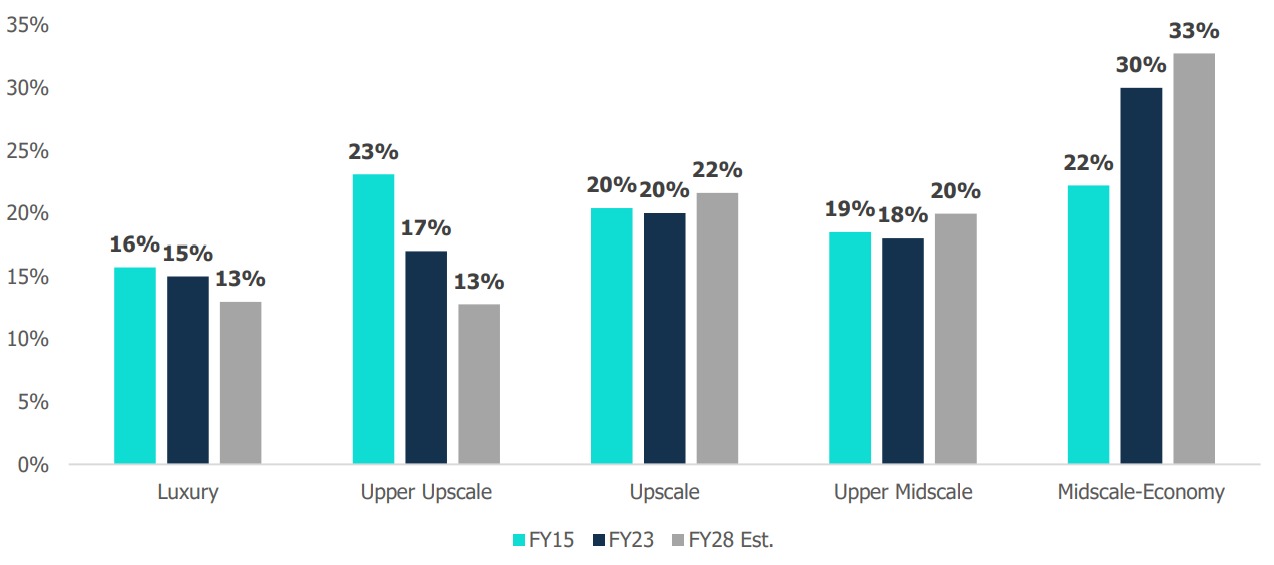
The segment mix is shifting towards Upper Midscale and Midscale Economy, with more than 60% of new supply expected to be added in these segments. The hotels are scaling these segments because that is where demand, returns, and scalability intersect. Midscale taps India’s fast‑growing middle class and domestic business/leisure travel, especially from tier‑2/3 cities that want branded but affordable stays rather than luxury.
Development cost per key and opex are materially lower than upscale/luxury, so midscale delivers better RoCE and faster payback while still supporting decent ADR and healthy occupancies.
The segment is also easier to roll out at scale on smaller land parcels, allows standardised prototypes, and is more resilient in downturns, which makes it the preferred growth engine for most chains today.
For example, Indian Hotels Company has recently acquired Clarks Hotels & Resorts (135 hotels, ~7,000 keys) under the Ginger brand, scaling presence in the midscale segment.
The chart below shows the past and expected supply between the different segments:
Source: CareEdge Ratings
11) Booking Channel Mix:
a) Direct Hotel Website: Booking through the hotel’s own website is one of the highest-margin channels for hotels because there are no OTA commissions involved. Guests benefit from transparent pricing, best-rate guarantees, and access to exclusive offers or member-only discounts. For hotels, this channel strengthens brand loyalty, improves profitability, and provides valuable customer data for future marketing and upselling.
b) Loyalty Program: Hotel brands increasingly push guests to book through their apps, such as Taj’s NeuPass app, Marriott Bonvoy, Hilton Honors, or IHG One Rewards, because these channels combine direct booking benefits with loyalty retention. Guests earn points, get digital check-in, upgrades, or faster service. For the hotel, the margin is equally strong as direct web bookings, and loyalty apps often deliver the highest lifetime value customers.
c) Online Travel Agencies (OTAs): OTAs like Agoda, MakeMyTrip, Expedia, Goibibo, etc., provide massive visibility, customer reviews, instant confirmations, and price comparisons. However, they charge hotels high commissions (12–25%), making them one of the lowest-margin channels. Despite the cost, OTAs help fill rooms in off-peak periods and attract new customers who may not otherwise discover the property.
d) Corporate Bookings: Large companies make deals with hotel brands at negotiated corporate rates. These bookings provide stable weekday demand and predictable occupancy, especially important for business hotels. Margins are moderate, lower than direct channels but usually higher than OTA bookings, because corporate rates are discounted but do not incur heavy commissions.
12) GST 2.0 Effect on Midscale Hotels:
Under GST 2.0, hotel rooms priced at ₹7,500 or below now attract a lower 5% GST, down from 12%, but input tax credit (ITC) is no longer allowed for these rooms.
This change directly impacts mid-scale hotels, as a large portion of their inventory falls under this tariff band. While the reduced GST rate makes stays more affordable and may help boost occupancy, the loss of ITC increases operating costs because hotels can no longer offset GST paid on inputs such as housekeeping supplies, maintenance, utilities, F&B, or services.
As a result, mid-scale operators face margin pressure and may need to absorb higher costs, raise base rates, or tighten expenses to maintain profitability, while hotels priced above ₹7,500 retain ITC benefits.
13) Talent Scarcity:
In India, the hospitality sector has long struggled to attract sufficient skilled labour. A major reason is that working in hotels typically involves long hours, shift work (nights, weekends), and physically demanding staff duties.
Entry-level pay in many roles (housekeeping, kitchen staff, front desk) is often low, especially after accounting for the irregular hours and high workload. This makes the sector unattractive to many young people, especially compared to careers perceived as “stable” or offering regular working hours.
In 2024, more than 8,600 hotel-management seats across India went unfilled, and by mid-2025, over 6,800 seats still remained unfilled. Entry-level turnover in the hospitality sector is alarmingly high at 50–70%, reflecting not just a talent shortage but the industry’s struggle to retain newcomers.
According to the Tourism and Hospitality Skill Sector Council study, only ~1% of the hotel-industry workforce had undergone formal training by 2022, even as demand for skilled and semi-skilled workers continues to rise.
The hospitality sector needs not only a larger workforce but a competent one. This makes structured skilling essential. Effective hospitality training can equip young people to manage challenging situations, deliver exceptional guest experiences, and eventually rise into supervisory and leadership roles.
Key Industry Metrics:
1) Occupancy Rate:
This shows what percentage of the hotel’s available rooms are occupied over a period. For example, 70 out of 100 rooms are occupied, i.e. occupancy rate is 70%.
High occupancy means the hotel is attracting steady demand. For investors, occupancy stability across seasons and downturns is a major sign of brand strength and market positioning. It directly influences pricing power and profitability.
2) Average Daily Rate (ADR) / Average Room Rate (ARR):
ADR / ARR represents the average price paid per occupied room. For example, there are 10 rooms available, out of which 5 rooms are booked for a total amount of ₹50,000. Hence, ADR is ₹10,000. Each room can have a different booking rate.
It is a pure measure of pricing power, brand strength, and market positioning. Rising ADR without sacrificing occupancy indicates that the hotel is moving up the value curve and commanding a premium in its market segment.
Mostly, there is a trade-off between occupancy rate and ADR. If the hotel wants to increase ADR, then the occupancy rate would dip.
3) Revenue per Available Room (RevPAR):
RevPAR = ADR × Occupancy Rate. This is the single most important hotel performance metric because it captures both demand and pricing. A hotel can increase occupancy or raise rates, but RevPAR shows whether the property is truly improving revenue efficiency on a room basis.
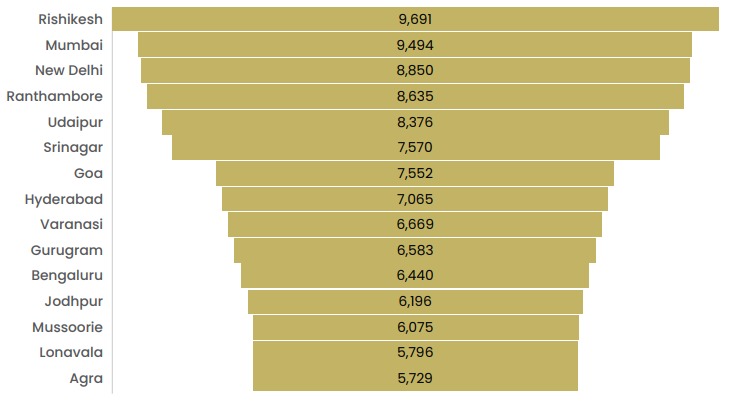
The chart below shows the top 15 hotel markets in India by RevPAR as of FY25:
Source: Hotelivate
4) Total Revenue per Available Room (TRevPAR):
This expands RevPAR to include all revenue sources: rooms, F&B, spa, events, banquets, parking, etc. It reflects how well a hotel monetises each guest across the entire property, not just through room sales. Upscale and luxury hotels rely heavily on TRevPAR growth because they have a decent portion of sales coming from other sources.
5) Gross Operating Profit per Available Room (GOPPAR):
GOPPAR measures profitability after operating expenses, not just revenue. It reflects both revenue strength and cost control. It’s a critical metric because hotels have high fixed costs. Improving GOPPAR shows improved operating efficiency and better management discipline.
6) Revenue per Occupied Room (RevPOR):
This indicates how much revenue (room charges plus other revenue sources) is generated from each occupied room. It shows the hotel’s effectiveness in upselling and cross-selling (e.g., F&B, spa, activities, etc.). Higher RevPOR indicates better guest monetisation and stronger ancillary services.
7) RevPAR Premium:
RevPAR Premium is the percentage difference in RevPAR between a hotel brand and its peers. It shows how much more (or less) revenue the hotel earns per room compared to the market peers.
A RevPAR Premium indicates that a hotel is outperforming the market due to stronger demand, better pricing power, brand recognition, location advantage, or superior service quality.
8) Loyalty Program Contribution:
Loyalty Program Contribution measures how much of a hotel’s total bookings or revenue comes from guests who are members of its loyalty or rewards program. It reflects the strength of repeat business, customer loyalty, and the brand’s ability to generate direct demand without relying heavily on third-party channels.
9) Guest Profile Mix:
The guest profile mix (foreign vs domestic, business vs leisure, airline crews, etc.) helps assess how dependent the hotel is on specific customer segments. Airline crew contracts and long-stay guests provide a reliable base occupancy, but they usually come at lower room rates, which decreases ADR. However, during downturns, this base demand becomes valuable, allowing the hotel to protect occupancy and manage daily ADR to maximise RevPAR.
Disclaimers:
1) I am not a SEBI-registered Research Analyst.
2) I do not own the stocks mentioned in the article as of the published date.
Related Articles

Hospital Industry Analysis
The Indian healthcare market is valued at ₹10.7 trillion in 2024. It primarily comprises 4 segments - Hospitals, Medical Devices, Pharmaceutical, and Diagnostics. Out of these 4 segments, the hospital segment accounts for ~60% of the overall market, i.e. ~ ₹6.4...